
What the Numbers on a Cheque Mean: MICR Line Explained
What you're looking at when you look at the MICR line
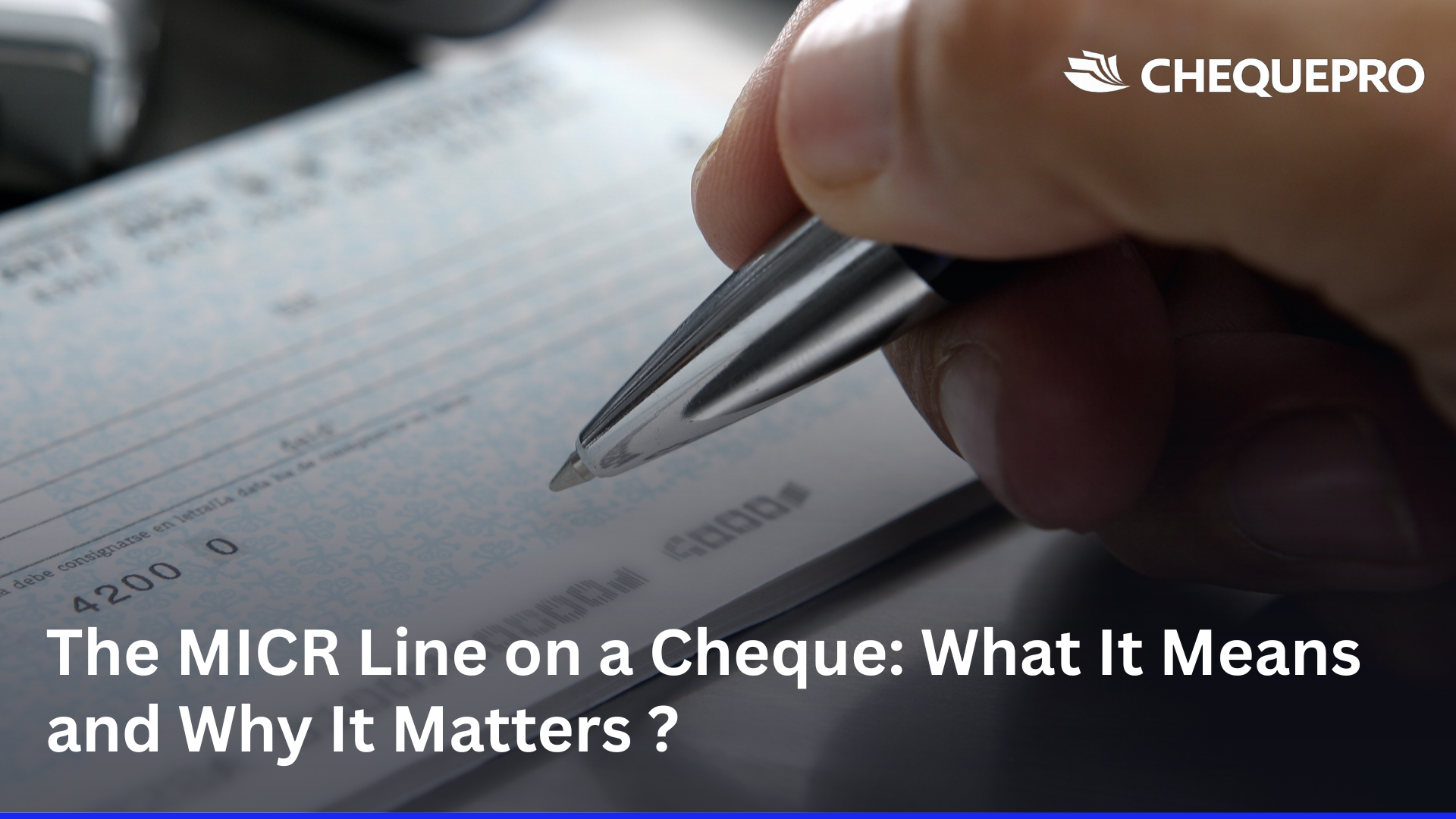
Pick up any modern cheque. Along the bottom edge, you'll see a single line of digits in an oddly geometric font, often broken into three or four groups by symbols. That row is the Magnetic Ink Character Recognition line, almost always abbreviated to MICR (pronounced "mike-er"). Every cheque on the planet that goes through automated clearing has one, and it is the most quietly important feature on the paper.
The MICR line is what allows banks to process tens of millions of cheques a day without humans typing in each one. The digits are printed in magnetic ink, and high-speed cheque sorters read the line at speed, route the cheque to the right clearing system, and credit and debit the relevant accounts. Without that line, every cheque would need manual data entry. The line is why a cheque you deposit on Monday in London can clear into a current account in Manchester by Tuesday afternoon.
If you've ever wondered why banks insist on cheques staying clean at the bottom (no folding through the MICR band, no stapling, no rubber stamps along the lower edge), this is why. Damage the MICR line and the cheque drops out of automated processing entirely, slowing settlement and costing the bank time.
The two MICR fonts: E-13B and CMC-7
There are two MICR fonts in use globally, and they do not overlap. Which one you see depends on where the cheque was issued.
E-13B is the dominant font, used in the UK, USA, India, Singapore, Hong Kong, the Gulf states, Malaysia, the Philippines, Kenya, Nigeria, Sri Lanka, and most other cheque-using markets worldwide. It contains the digits 0 to 9 and four special control characters (transit, on-us, amount, and dash). The shapes look slightly chunky and angular.
CMC-7 is used primarily in France, Spain, Portugal, Brazil, and several other Latin American and southern European countries. Each character is made of a series of vertical bars. Same purpose, different encoding.
What each part of the MICR line means
The exact field layout varies slightly by country, but the structure is similar everywhere. On a typical Indian, Gulf, or Southeast Asian cheque using E-13B, the MICR line reads (left to right):
- Cheque number: the serial number of this specific cheque leaf in your chequebook.
- MICR code (city + bank + branch): a 9-digit numeric block identifying where the account sits. In India this breaks down as 3 digits for city, 3 for bank, 3 for branch.
- Account number: the payer's account, encoded into the line so that the cheque sorter knows which account to debit.
- Transaction code: typically a 2-digit code indicating the cheque type (savings, current, multicity, etc.).
On a UK cheque, the sort code (6 digits) sits before the account number (8 digits), with the cheque number to the left of both. Same idea, slightly different layout.
Why MICR specifically?
The MICR system dates to the late 1950s. The decision to use magnetic ink rather than optical scanning was deliberate and clever. Magnetic ink can be read even if the cheque is dirty, stamped, scribbled on, or photocopied, because the magnetic signature comes from the ink itself, not the surface appearance. Optical character recognition fails the moment a cheque gets a coffee stain across the line. MICR ploughs through.
Today most clearing systems are image-based: the cheque is photographed, the image is sent through the network. But the MICR line on the image is still read magnetically at the entry point of the clearing system, both for accuracy and as a fraud check.
What this means for printing cheques
If you are filling in cheques manually, the MICR line is none of your business. Do not write near it, do not fold across it, do not stamp on it.
If you are printing cheques from software like ChequePro, the software needs to know where the MICR band sits on your specific bank's cheque so it never prints over it. ChequePro's bank templates and alignment engine respect this band automatically. When you create a custom template for a new bank, the alignment engine asks you to position the printable fields above the MICR band; everything below the cutoff is left untouched. This is one of the key advantages over a cheque writer machine, which stamps blindly and can mark the MICR band.
The two things that can go wrong with a MICR line
Physical damage. A cheque that has been folded through the MICR band, or has a sticker, staple residue, or pen mark crossing the line, may drop out of automated processing. When in doubt, store cheques flat and keep stamps and stickers above the MICR band.
Reprinted or photocopied cheques. A cheque that has been photocopied loses its magnetic signature even if the digits look identical. Photocopied cheques are not honoured. If you need to reissue a cheque, void the original and issue a fresh one.
The MICR line and CTS-2010 compliance
In India, all current cheques are CTS-2010 compliant, meaning they meet the Cheque Truncation System standards introduced by the Reserve Bank of India. The digit positioning, the font weight, the magnetic ink density, and the size of the safe zone are all defined. The same kind of standardisation exists in other markets: the Image Clearing System in the UK, the CICS in the Philippines, the LankaClear CITS in Sri Lanka, and so on.
For ordinary users, the takeaway is short: any chequebook you have right now from any major bank is compliant. You do not need to worry about it.
Frequently asked questions
What does MICR stand for?
Magnetic Ink Character Recognition. The MICR line is the row of digits printed in magnetic ink along the foot of every cheque, used for high-speed automated clearing.
Why is MICR magnetic and not just printed?
Magnetic ink can be read even if the cheque is dirty, stamped, or partially marked. The magnetic signature is generated by the ink itself, not the visual surface, which makes the read process highly reliable in real-world cheque-processing conditions.
Is the MICR line the same as the IFSC or sort code?
No. The MICR line is the full row of digits at the foot of the cheque, identifying the cheque number, branch, account, and transaction type. The IFSC (India) or sort code (UK) is just one part of that identification, used for electronic transfers as well as cheques.
Can I print my own MICR line?
For cheques in cheque-using markets (UK, India, Gulf, Asia, Africa), no, and there is no reason to. Your bank prints the MICR line on every cheque leaf when the chequebook is issued. ChequePro prints onto your pre-printed chequebook, leaving the existing MICR line untouched.
What happens if the MICR line on a cheque gets damaged?
The cheque drops out of automated processing and has to be handled manually by the clearing bank. Settlement is slower and there is usually a fee. Keep cheques flat, do not fold through the MICR band, and do not apply stickers or stamps along the lower edge.
What's the difference between E-13B and CMC-7?
They're the two MICR fonts in use globally. E-13B is used in the UK, US, India, Gulf, and most Asian and African markets. CMC-7 is used in France, Spain, Portugal, Brazil, and parts of Latin America.
Print cheques accurately and securely
Free version, no credit card. Works with any printer and your existing chequebook.
Download Free